
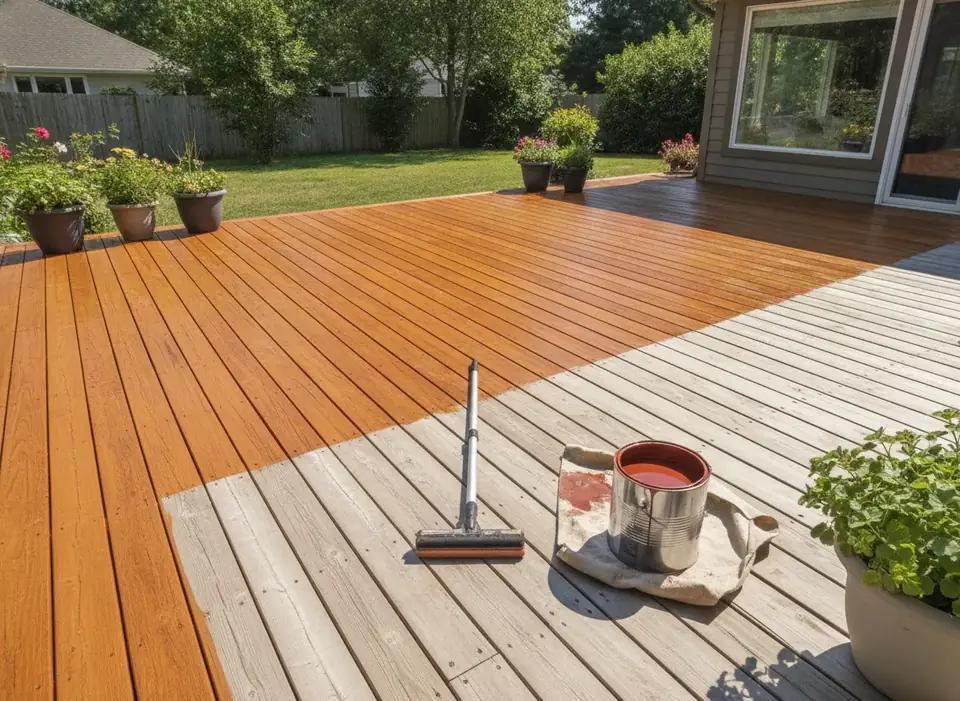
For a wood deck in Colorado's strong sun, use a penetrating finish such as a semitransparent stain or a pigmented water-repellent preservative, not a film-forming finish like paint or solid-color stain. The USDA Forest Products Laboratory recommends penetrating finishes for decks and notes that pigment is what blocks the UV that grays and breaks down wood. Apply it to clean, dry wood in good weather, which in Denver mostly means the stretch between the median last spring freeze (May 5) and first fall freeze (October 9). On horizontal deck boards, plan to recoat a semitransparent stain about every 2–3 years.
Why sun is the main enemy of a deck finish here
The Forest Products Laboratory lists UV radiation, water and abrasion as the causes of wood weathering (USDA FPL, Finishes for Wood Decks; Wood Handbook, ch. 15). A deck gets all three: it faces the sky, holds snow and rain, and takes foot traffic.
Denver sits at 5,280 feet, and UV exposure rises with elevation (EPA). Summers are bright and hot: NOAA's 1991–2020 normals for Denver International Airport show a July average high of 89.9 °F and about 46 days a year at 90 °F or above (NOAA normals). Then the same boards sit through about 156 nights a year at or below freezing and roughly 47 inches of snow a year (NWS). That mix of strong sun and winter moisture is why a finish that looks fine in a catalog can fade fast on a south- or west-facing Front Range deck.
This guide does not give an "altitude lifespan" for a stain. No reliable source measures how much faster finishes wear in Denver than at sea level. What the evidence supports is simpler: more sun exposure means pigment matters, and horizontal surfaces wear faster than walls.
Penetrating vs film-forming finishes
| Finish type | How it works | On a deck |
|---|---|---|
| Water-repellent preservative (clear) | Soaks in; sheds water | Protects from moisture, but with no pigment it gives little UV protection |
| Pigmented water repellent / semitransparent stain | Soaks in; pigment blocks UV | Recommended by FPL for decks; wears away gradually instead of peeling |
| Solid-color stain, paint, varnish (film-forming) | Forms a surface film | FPL advises against these for decks; foot traffic and moisture lead to cracking and peeling |
The key point from FPL's deck finish guide is that a penetrating finish fails gracefully. It slowly weathers away, and the next coat goes on after a cleaning. A film that peels has to be stripped, which is slower and costs more.
Color is a trade-off too. A clear finish lets the wood's color show but leaves it exposed to UV. More pigment means more UV protection and a less natural grain look. On a sunny deck, a semitransparent stain with real pigment is the usual middle ground.
How long a deck stain lasts
A trade source, the Journal of Light Construction, puts semitransparent stain at about 2–3 years on horizontal deck surfaces. FPL's general range for semitransparent stains on wood is wider, 3–8 years (FPL Finish Line), but that figure covers vertical siding too, which wears far more slowly than a deck you walk on. Railings and vertical boards on the same deck often look fine after the floor has faded.
The practical test: if water no longer beads on the boards and the color has worn through in the traffic paths, it is time to clean and recoat.
When to stain a deck in Denver
FPL's guidance is to apply finishes to clean, dry wood in suitable weather. Denver's calendar sets the window:
- Spring: the median last freeze at Denver International Airport is May 5 (NOAA). Early spring often brings snow and wet boards, so staining usually waits until nights warm up and the wood has dried out.
- Summer: long dry stretches help, but May (2.16 in.) and July (2.14 in.) are the wettest months, mostly from afternoon storms (NOAA monthly normals). Morning work and a clear forecast help. Follow the label for temperature and dry time.
- Fall: September is often a good fit. The median first freeze is October 9, so leave time for the finish to cure before cold nights.
Plan early if you want a contractor. Searches for "deck staining Denver" spike in March, well before the weather allows the work, so spring schedules can fill up.
Prep matters more than the brand
- Clean first. Dirt, mildew and grayed wood fibers keep stain from soaking in.
- Strip only if needed. A peeling film finish has to come off before a penetrating stain will work.
- Let it dry. Wood should be dry after washing and after rain before stain goes on.
- Fix boards first. Replace split or soft boards and set loose fasteners before finishing. Hail can also pit wood surfaces; Colorado sits in "hail alley," which NOAA's NSSL says averages seven to nine hail days a year (NSSL).
What deck staining costs in Denver
Published cost guides (2025–2026) list washing, staining and sealing at about $1.57–$4.04 per sq ft, and stripping plus refinishing at about $3.00–$6.50 per sq ft (HomeGuide). These are estimates, not quotes. For a 12x16 deck (192 sq ft), that works out to roughly $300–$775 for a standard stain job before any repairs. The Denver deck cost calculator lets you run your own square footage.
If you are tired of the cycle, composite decking avoids staining but costs more up front; our composite vs wood comparison walks through that choice. See also deck staining & sealing in Denver, wood decks and composite & PVC decks.
Get a staining quote
We connect Denver-area homeowners with independent local deck builders for free, no-obligation quotes. The contractor you choose quotes, permits, contracts and builds directly with you. Request a free quote for cleaning, staining or refinishing, and ask each contractor which finish they recommend for your deck's sun exposure.